
Decoding Product-Market Fit: Why Great Founders Build for the Micro


Recent technological shifts, particularly AI and vibe coding, unlock unprecedented opportunities for modern entrepreneurs. The capacity to bring new technical products to market quickly and inexpensively has expanded dramatically. Today, founders no longer ask, "Can I secure the funding to build a Proof of Concept?" Instead, founders ask, "Which Proof of Concept should I build, and how can I test market demand rapidly?" This shift makes analyzing Product-Market Fit (PMF) necessary to survive and thrive in the long-term.
Venture capitalist Marc Andreessen coined the popular term Product-Market Fit, but the underlying dynamic stems from classical economic principles. Centuries ago, classical economists like Adam Smith identified market equilibrium as an emergent invisible hand guiding supply and demand. In turn, the market forces are driven by moral sentiments, self-interests, and voluntary trade. Product-Market Fit represents the modern software equivalent of classical economic balance. Marc Andreessen popularized the terminology for Silicon Valley, but the core mechanics rest on time-tested economic laws and human nature.
An ambitious founder often starts with a grand macro vision. You see an economic inefficiency or an untapped market, and you envision a future where your solution changes how people live, work, or manage money. Inspiration provides necessary direction, but inspiration also creates a dangerous trap.
Startup history contains many founders falling in love with a macro vision and building a grand solution for how the world should work, only to launch to deafening silence. Creating new products in a dynamic world is tricky. There is a reason why the world works as it does, and moving it to how it should work is both challenging and not the true objective. Alternatively, successful founders have a vision and humility for where the world is actually going, not a judgment for where they think it should go. This is a subtle but important distinction. Founders who achieve true PMF realize early on that while vision acts as a compass, growth relies on the micro. Plus, the macro vision is informed and updated by the micro. A successful startup's foundation is a micro understanding of human behavior and the humility to serve human needs.
PMF requires no magic. PMF represents the economic alignment of micro-level human behavior, immediate utility, and scalable incentives. Successful entrepreneurs master the micro to build enduring macro-facing enterprises through specific, repeatable steps.
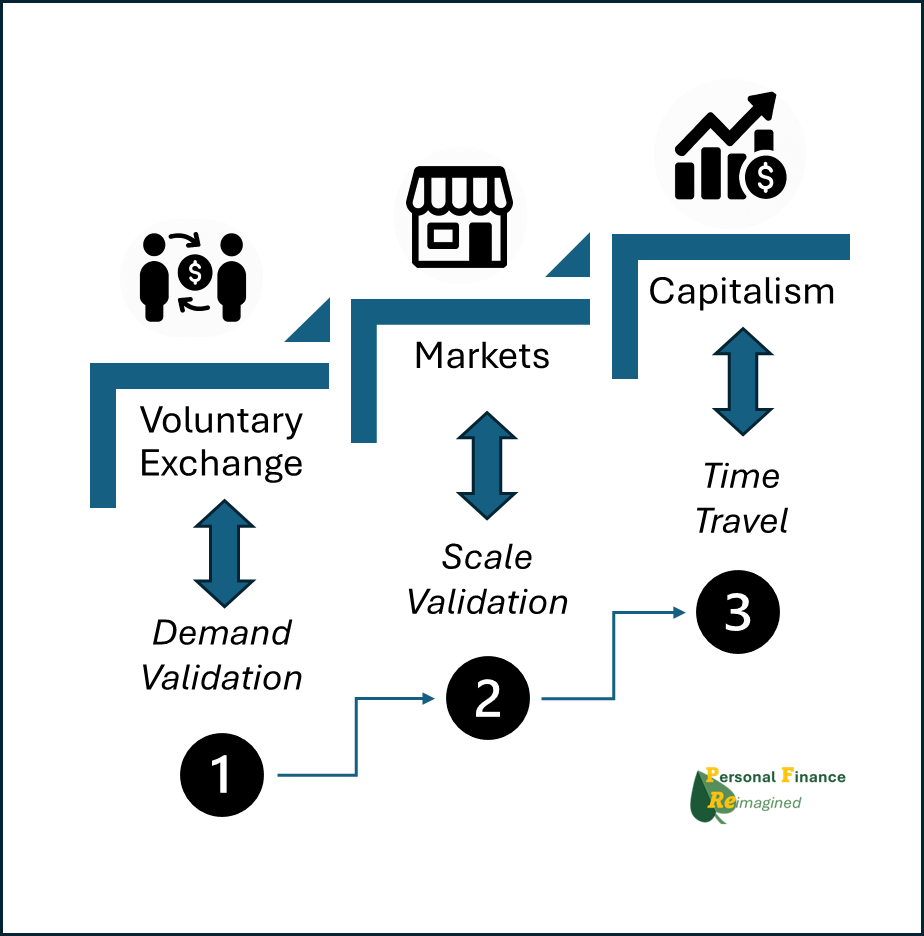
Level 1: Voluntary Exchange and "Micro-Fit"
Understanding demand and staying anchored to real customer needs forms the core of entrepreneurial success.
Economics does not begin with broad industries, large markets, or total output. Economics begins with a single voluntary exchange. I call it "Client 0." This is the very first "real" client buying an entrepreneur's "real" product. "Real means an independent, authentic trade. A transaction occurs only when two parties willingly trade because both parties believe the exchange improves their current situation.
In startup terms, this dynamic creates Micro-Fit, proving a single human being will trade hard-earned money or precious attention for a solution today.
Successful founders obsess over the micro because these founders understand human psychology and daily behavioral friction. People have choices and people are decidedly NOT robo-rational creatures:
Failure Of Invariance: Humans differ from moment to moment, influenced by how they feel and their immediate surroundings.
Present Bias: Humans heavily discount future benefits in favor of immediate relief. A feature promising to save a user money six months from now offers little perceived value today compared to a feature eliminating a frustration right now.
The Ostrich Effect: When confronting a problem induces anxiety, such as reviewing a chaotic budget or examining complex medical statistics, people actively avoid the task.
Perceived Utility versus Actual Utility: A founder might build incredible long-term actual utility, but without immediate perceived utility, no exchange occurs.
Loss Aversion: Humans generally value a loss at about double that of a gain. Even when an objective comparison shows the loss and gain as being equivalent.
And so on.... I just picked a few of our psychological quirks.

The Micro-Fit Rule: A founder earns the right to execute a macro vision only by solving an acute micro-pain first.
Uber envisioned reimagining urban transit, but its initial micro-fit solved an immediate problem: building trust to help someone get a ride on a rainy night in SF. Solve the sixty-second problem first.
Level 2: Markets and "Macro-Fit" (True PMF)
Once the entrepreneur solves the Micro-Fit, the business enters Level 2: The Market.
A market represents the aggregation of individual micro-exchanges. Within a market, price signals, network effects, and customer feedback loops take control. This phase reflects the classical definition of PMF: operating in a strong market with a product satisfying market demand.

This transition highlights the value of updating our daily execution strategies. Under a traditional approach, an uncalibrated founder attempts to push a product onto an indifferent market. A calibrated approach swaps force for alignment. The savvy founder identifies existing market pull, aligns product utility with immediate customer demand, and lets market demand pull the enterprise forward:
Before PMF (Push Dynamics): The founder pushes the product onto the market. Customer acquisition costs remain high, user retention leaks steadily, and every sale feels like rolling a heavy boulder uphill.
After PMF (Pull Dynamics): The market pulls the product out of the enterprise, usage grows organically through word-of-mouth recommendations, retention curves stabilize into a healthy baseline, and the primary operational challenge shifts from finding users to meeting demand.
Level 2 PMF means micro-utility addresses a widespread, shared pain point across a distinct customer segment. The business stops convincing people a problem exists; the business stands before an active freight train of market demand.
The Institutional Bridge: Solving the Long-Term Payoff Problem
Some macro visions focus on long-term payoffs, such as building financial health, maintaining preventative healthcare habits, or advancing career skills. When individual consumers bound by present bias hesitate to pay out-of-pocket for distant benefits, who covers the cost?
Sharp founders leverage institutional alignment. When the end-user lacks immediate incentives to pay for long-term value, external institutions often hold substantial economic skin in the game:
Universities seek higher retention and graduation rates to secure tuition revenues.
Employers seek higher productivity and lower turnover to protect operating margins.
Insurance Providers seek lower long-term claims to preserve underwriting profitability.

By shifting the business model from direct consumer sales to an institutional partnership structure, a founder aligns underlying economic incentives:
The Institution pays for the platform because the tool protects bottom-line margins or reduces operational risk.
The Individual receives access without financial friction, allowing immediate engagement through micro-wins without confronting a pricing barrier.
This structural shift highlights the value of updating our distribution models. Under a traditional approach, an uncalibrated founder attempts to convince reluctant consumers to purchase self-improvement tools out-of-pocket. A calibrated approach swaps direct consumer sales for structural alignment. The savvy founder identifies institutional incentives, secures payment from the party benefiting from long-term compliance, and delivers the platform directly to end-users for free.
Level 3: Scalable Operations and Post-PMF Growth
Only after achieving Level 1 Micro-Fit and Level 2 Market Pull should a founder transition to Level 3: True Capitalism.
Level 3 focuses on deploying capital, building operating systems, creating leverage, and constructing competitive moats. This phase introduces the core time-travel problem capital helps solve. Once a product passes Level 1 and Level 2, the enterprise must build and distribute inventory today, while customer revenues or contract payments arrive in the future. Capital bridges this temporal gap, acting as a functional time machine, funding current operational costs against future cash flows.
Capitalists seldom provide funds for unproven concepts. Experienced investors deploy capital into products with proven Product-Market Fit needing operational help to scale.
The primary cause of early-stage failure remains premature scaling, such as pouring capital into heavy marketing, hiring sprees, and complex infrastructure before proving Level 1 and Level 2 fit. Capital acts as an amplifier. Applied to a product with genuine market pull, capital creates substantial enterprise value. Applied to a product lacking micro-fit, capital simply burns available cash faster.
The Founder's PMF Diagnostic
To evaluate a product through this economic lens, apply these three micro-checks:
The Sixty-Second Hook: What immediate pain does the product relieve in the first sixty seconds of use? Does the user experience immediate relief, or does the product demand effort today for a distant payoff?
The Market Signal: Does the market pull the product forward naturally, or does the enterprise spend capital pushing the offer uphill?
The Incentive Check: If the product delivers a long-term benefit, does the design force the end-user to foot the bill, or does the enterprise partner with an institution benefiting from long-term success?
Think of these questions as suggestions for investigation and creativity. Invariably, one or more of these may be suspect. The idea is to test and learn, with an objective to improve PMF.
Macro visions inspire teams, but micro-utility wins markets. Solve immediate operational pain today, build the system scaling that solution tomorrow, and allow market demand to pull the enterprise toward the vision.
About the author: Jeff Hulett leads Personal Finance Reimagined, a decision-making and financial education organization. He teaches personal finance at James Madison University and provides entrepreneurial services. Check out his book -- Making Choices, Making Money: Your Guide to Making Confident Financial Decisions.
Jeff is a career banker, data scientist, behavioral economist, and choice architect. Jeff has held banking and consulting leadership roles at Wells Fargo, Citibank, KPMG, and IBM.


Comments