
The Beyond-The-Office Economy: What Buffett, Munger, and Gayner Teach Us About the Future of Work

Updated: Aug 20
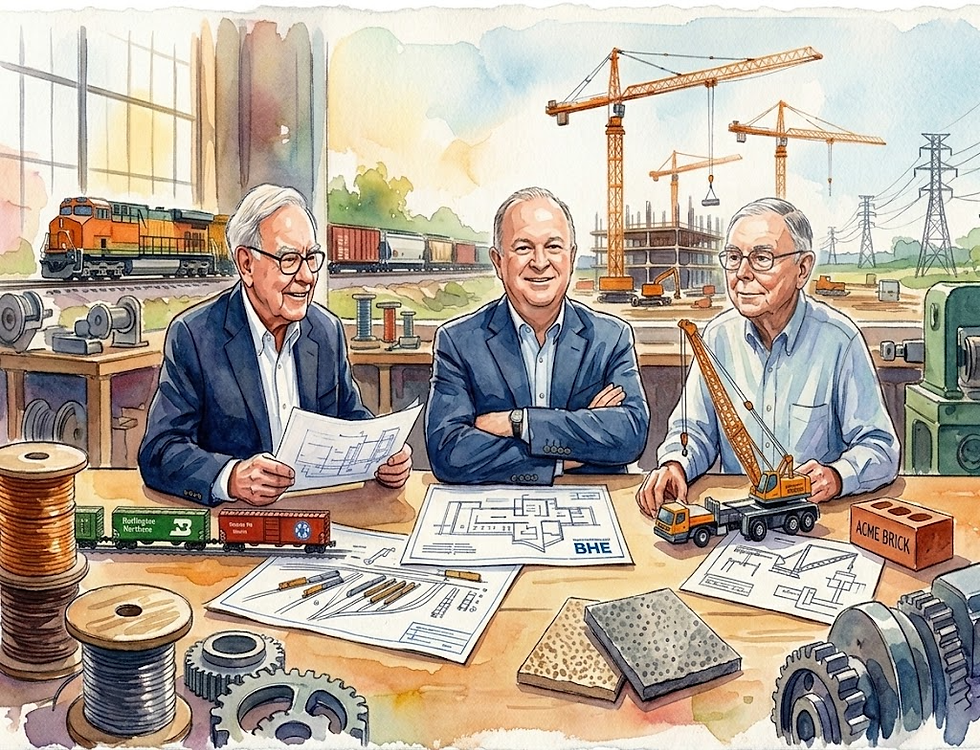
Ever since the Information Era took off in the 1970s, American culture operated on an implicit promise: a college degree offered the ticket out of physical labor, and a clean office job provided the primary signal of success. For the last half century, parental pride measured success by whether children took a shower before work instead of after.
That cultural contract served workers well for decades. Not any longer.
Today, artificial intelligence systematically automates the rule-based, information-processing roles forming the bedrock of corporate career paths. Acting as a digital conduit between spreadsheets or drafting routine status reports is rapidly shrinking as an entry-level career path. Doing basic operational work remains an essential way to learn how an organization actually functions. However, AI handles these tasks at a speed and cost that make it more difficult to justify using it as a human training ground. These foundational roles will not disappear entirely because AI cannot handle every complex real-world case, but fewer of these seats will exist. Plus, where there is a will. there is a way. If companies can use AI to drive down costs, increase quality, and improve competitive positioning, they will. AI use cases are just beginning.
When software scripts replace standardized knowledge work, what remains for human beings? More importantly, what does this shift mean for how founders build businesses and capital allocators invest in an AI-driven world?
The answer lies in a framework three visionaries—Warren Buffett, Charlie Munger, and Tom Gayner—utilized to compound capital over decades: the enduring value of messy, real-world complexity. For decades, these visionaries have recognized the value of messy jobs.
1. The Death of Codifiable Moats
In both careers and investments, lower-friction, higher-compensated pathways attract hyper-competition.
For forty years, the market placed large premiums on structured, asset-light business models and white-collar roles. Yet AI fundamentally flips this equation. When a job or business breaks down into standard, codifiable rules, AI pushes the marginal cost of execution toward zero.
In Careers: When a job relies primarily on digital and rule-based tasks, the role transforms into an algorithmic training set.
In Business: When software creation encounters lower technical friction, digital-only moats erode quickly. A sleek SaaS tool requiring millions to build in prior years quickly faces competition from low-cost market alternatives.
2. What Remains for Humans? (The Data Behind the Unscripted Advantage)
This shift is largely positive. Jevons Paradox shows that when the cost of a key input falls, such as the automated cognition provided by AI, the overall demand for related output surges. As the cost of routine software work drops toward zero, demand for complex real-world solutions will increase dramatically.
As codifiable tasks shift into code, human value concentrates where software meets physical friction: tactile execution, non-standard judgment, and unscripted empathy.
The statistics make this structural mismatch clear. Data from the Federal Reserve Bank of New York shows overall underemployment among recent college graduates edges past 42 percent. However, when broken down by major, the divide between codifiable office roles and hands-on, unscripted disciplines becomes stark.
Business Management (4-Year Bachelor's)
Primary Job Character: Standard office workflows, codifiable coordination
Underemployment Rate: 52.2%
Communications (4-Year Bachelor's)
Primary Job Character: Digital content, marketing coordination, text editing
Underemployment Rate: 51.8%
Marketing & Market Research (4-Year Bachelor's)
Primary Job Character: Data collection, standard digital analytics
Underemployment Rate: 48.7%
Nursing (4-Year Bachelor's / BSN)
Primary Job Character: Tactile patient care, unscripted physical execution
Underemployment Rate: 11.4%
Special Education (4-Year Bachelor's)
Primary Job Character: In-person behavioral and physical management
Underemployment Rate: 15.1%
Source: Federal Reserve Bank of New York, Labor Market for Recent College Graduates.
Structural research from the Federal Reserve confirms this shift, noting that the traditional employment premium for recent college graduates continues to narrow as artificial intelligence automates entry-level cognitive tasks. Furthermore, national survey data from the Lumina Foundation and Gallup reveal that over 40 percent of bachelor’s degree students actively reconsider their chosen field of study due to technology disruption, with 16 percent executing an outright major change. Rather than reflecting a cyclical shift, student behavior points to a growing recognition of a permanent economic realignment: standard rule-based knowledge roles face increasing operational headwinds, while hands-on, unscripted disciplines maintain their long-term structural advantage.
While white-collar graduates encounter intense competition for entry-level office jobs, the demand for hands-on, unscripted roles spans the entire educational spectrum. From advanced post-graduate degrees down to high school trade entry.
Data from the U.S. Bureau of Labor Statistics (BLS) projects the fastest-growing occupations over the coming decade lean heavily toward physical, tactile, and field-heavy work.
Wind Turbine Service Tech
Required Education: Postsecondary Certificate
Unscripted Character: Climbing high structures, heavy mechanical repair in outdoor elements
Projected Job Growth: +50% (Fastest-growing in the U.S.)
Median Annual Pay: $62,580
Solar PV Installer
Required Education: High School Diploma
Unscripted Character: Rooftop assembly, outdoor physical labor, grid connection
Projected Job Growth: +42%
Median Annual Pay: $51,860
Nurse Practitioner
Required Education: Advanced Degree (Master’s / Doctorate)
Unscripted Character: Direct patient diagnosis, clinical procedures, physical care management
Projected Job Growth: +40%
Median Annual Pay: $129,210
Physical Therapist Assistant
Required Education: 2-Year Associate Degree
Unscripted Character: Hands-on physical rehabilitation, patient mobility work
Projected Job Growth: +22%
Median Annual Pay: $65,510
Electrician
Required Education: High School + Apprenticeship
Unscripted Character: Complex physical wiring, site troubleshooting, safety codes
Projected Job Growth: +11% (High-volume openings)
Median Annual Pay: $61,590
Source: U.S. Bureau of Labor Statistics, Occupational Outlook Handbook.
Whether a Nurse Practitioner manages clinical cases with a Master's degree, or a Solar Installer assembles arrays on a rooftop, the common denominator involves physical, hands-on, unscripted execution. AI generates project schedules with ease, yet algorithms encounter physical limitations when threading electrical conduit or inserting an IV.
3. The Visionaries Who Saw It First: Buffett, Munger, and Gayner
Long before generative AI began shifting corporate workplace dynamics, Warren Buffett, Charlie Munger, and Tom Gayner recognized cultural signaling preferences frequently limit economic returns. They systematically built their corporate footprints by acquiring businesses operating in messy, physical, and unglamorous niches, often ignored by mainstream markets:
The Berkshire Moat: Betting on "Atoms Over Bits" (Buffett & Munger)
While modern markets chase digital scale and AI automation, Berkshire Hathaway built its compounding engine on physical friction, regulatory complexity, and heavy assets—businesses where code simply cannot replace physical presence:
BNSF Railway (Freight Logistics): AI can optimize train scheduling, but it cannot move millions of tons of heavy cargo over thousands of miles without steel rails, diesel engines, and physical right-of-way.
Berkshire Hathaway Energy (Grid Infrastructure): Managing high-voltage power lines, gas pipelines, and power generation requires navigating local geography, physical maintenance, and heavy regional regulation. Software doesn't lay pipe or maintain power lines.
Lubrizol & Industrial Subsidiaries (Specialty Chemistry & Materials): Formulating specialized lubricant additives, building materials, and industrial components requires deep integration into physical supply chains. Software doesn't change fluid dynamics or batch manufacturing.
Insurance Operations (GEICO & Reinsurance Engine): Managing physical risk, real-world catastrophe claims, and real-time capital allocation provides the cash engine (float) that funds these capital-heavy physical acquisitions.
The Markel Model: Physical "Un-sexy" Enterprise (Tom Gayner)
Under CEO Tom Gayner, Markel Group applies Berkshire's playbook. They use specialty insurance float to acquire 100% ownership in cash-generative, essential physical businesses through Markel Ventures:
Metromont Corporation: Manufacturing precast concrete structures for large-scale data centers, parking structures, and industrial developments. Heavy concrete assembly involves complex logistics and field site coordination.
Costa Farms: Operating massive agricultural operations as the largest producer of ornamental houseplants worldwide. Managing living biology and perishable nursery supply chains creates physical moats software cannot replicate.
Buckner HeavyLift Cranes: Operating massive crawler cranes for heavy industrial construction sites.
None of these business models operate as clean digital environments. They involve grease, weather, heavy machinery, and physical wear-and-tear. Because societal preferences discounted these sectors, Gayner and Buffett acquired cash flows at attractive valuations, relying on skilled field teams to manage operational complexity while headquarters compounded capital.
4. The New Playbook for Careers, Business, and Wealth
Whether building a career, launching a business, or allocating capital, the structural dynamics of the Beyond-The-Office Economy remain clear.
For Career Builders: Consider moving away from overcrowded application channels offering standardized, rules-based office roles. Lean into tactile skills, field management, specialized healthcare, skilled trades, and positions requiring unscripted real-world judgment.
For Entrepreneurs: Technology entrepreneurship continues to evolve rapidly. Thanks to AI tools and vibe coding, the capital and time required to build software, test MVPs, and automate workflows dropped significantly. Rather than building generic software tools, apply technology as a force multiplier for the physical world. Build software solving chaotic, unscripted problems in field services, supply chain logistics, local trade operations, or heavy industry. The primary founder moat today pairs modern software with messy, operationally complex execution.
For Investors: Look beyond digital valuation multiples. Focus on businesses operating physical assets, regulatory tollbooths, or specialized field operations facing minimal AI substitution—or firms leveraging AI to streamline historically messy, higher-margin niches.
The cleanest roles and flashiest business plans often carry structural fragility. Building a durable career or a compounding enterprise requires taking a cue from legendary capital allocators: look toward opportunities requiring real-world execution and messy operational depth.
College-ing Correctly: Rethinking Higher Education Value
These structural employment numbers inevitably prompt a second-order question: Is a college degree still worth the investment?
Higher Education remains a high-benefit pursuit, yet the underlying economic equation has changed. For decades, rising administrative overhead and expanding campus amenities pushed tuition costs higher relative to median household income. Students built trillions of dollars in cumulative debt supporting these price increases, relying on an implicit guarantee of an entry-level job upon graduation.

Sources: Federal Reserve, U.S. Census - > Median Household Income in the United States || NCES -> College Tuition & Fees (Nominal, Public 4-Year In-State, 2001–2024)
Today, viewing a degree as an entry-level job credential creates financial risk. Higher education institutions face their own economic soul-searching as automated software replaces standard corporate training roles.
Winning in the modern economy requires learning how to execute college correctly. Higher education offers extraordinary value when students utilize the experience to build enduring human capabilities:
Critical Thinking: Learning how to evaluate complex systems, question assumptions, and solve non-standard problems.
Social Capital: Building genuine networks, collaborating across diverse teams, and developing deep emotional intelligence.
Personal Management: Mastering time allocation, self-discipline, and independent decision-making away from home.
The strategic imperative today centers on cost management and deliberate choice. Students who minimize debt, seek practical internships, and evaluate fields through a lens of unscripted real-world value capture immense upside. Meanwhile, accessible non-college vocational pathways provide alternative routes to financial independence. Success no longer stems from simply possessing a diploma. Success belongs to those who allocate their educational time and financial capital with intention.
About the author: Jeff Hulett leads Personal Finance Reimagined, a decision-making and financial education organization. He teaches personal finance at James Madison University and provides entrepreneurial services. Check out his book -- Making Choices, Making Money: Your Guide to Making Confident Financial Decisions.
Jeff is a career banker, data scientist, behavioral economist, and choice architect. Jeff has held banking and consulting leadership roles at Wells Fargo, Citibank, KPMG, and IBM.


Well written! Thanks for addressing the "Is College Still Worth it?" question