
Reframing Artificial Intelligence in Education: Moving From Cognitive Crutch to Reasoning Partner

Updated: Sep 17
A steady stream of headlines paints a cautious picture of technology in the classroom:
"[It] makes the mind lazy. If you don’t use your brain to compute, your mental faculties will atrophy, leaving students completely dependent on [it] to do their thinking for them."
"How can a teacher accurately evaluate a child's true cognitive ability when [it] is doing the work behind their back?"
"If we substitute mechanical computation for human understanding, we will graduate a generation of illiterates who can follow instructions but cannot innovate."
These quotes sound like today’s concern over Artificial Intelligence, but they are pulled directly from 1970s editorials warning against the pocket calculator.
The parallel isn't perfect, as AI impacts higher-order synthesis in ways a calculator never could. However, the typical human pattern remains. Major technology leaps trigger an initial concern about mental atrophy. In 1545, following the rise of the printing press, Swiss scholar Conrad Gessner petitioned monarchs to restrict printing, warning that the "confusing and harmful abundance of books" would degrade human memory and lead to intellectual decay.
Society eventually adapts, but only when we shift from banning the tool to reimagining the pedagogy.
For AI, these warnings deserve consideration. Empirical trials evaluating passive artificial intelligence integration (situations where large language models function as passive answer generators) frequently document a decline in student problem-solving capabilities and critical thinking (Mollahosseini et al., 2024).
Dismissing artificial intelligence in education based on these outcomes misattributes the underlying cause. If a house collapses from poor construction, people do not blame the hammer. They blame the construction methods, such as how the builder chose to use the tool. Artificial intelligence in education presents a similar dynamic. Thus, how the teacher uses the tool matters. Current negative findings reflect a mismatch in instructional methodology rather than an inherent flaw in technology. Wright’s Law (positing capability improves as a function of cumulative experience) applies as much to technological adoption as it does to industrial manufacturing. As educators and students learn to orchestrate artificial intelligence intentionally, outcomes shift constructively.
Rebuilding education for an AI-augmented world requires a clear theoretical foundation to govern how learning occurs across different developmental stages and cognitive demands.
The Theoretical Anchor: Bloom’s Taxonomy as an AI Framework
Bloom’s Taxonomy provides a useful blueprint for aligning artificial intelligence interaction with human cognitive development. The framework categorizes learning into hierarchical levels, progressing from foundational mechanics (Remembering and Understanding) to executive judgment (Evaluating and Creating).
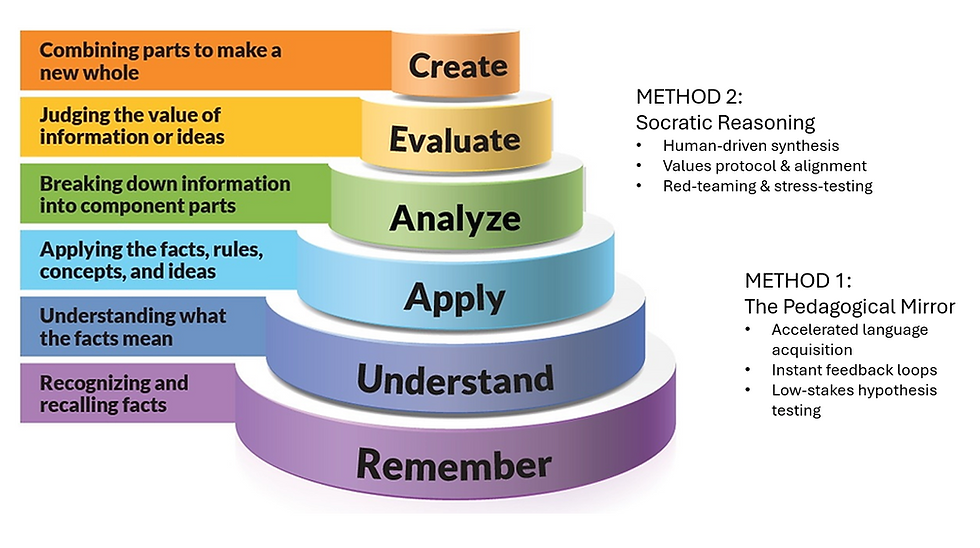
AI implementation challenges occur when schools apply tools indiscriminately across this hierarchy. When students use artificial intelligence inappropriately, such as generating essays or solving complex problems from scratch, they outsource across all tiers of Bloom’s Taxonomy. This outsourcing turns technology into a cognitive crutch, bypassing the mental effort required to build enduring mental models. This is also known as cognitive offloading. It is in our nature to "work smarter, not harder." But one can not work smarter with AI until they have worked harder in order to learn to orchestrate the AI. It is quite a paradox.
To transition artificial intelligence from a crutch into a reasoning partner, integration splits into two distinct, purpose-built methodologies anchored to specific tiers of the hierarchy:
Lower Tiers (Remembering to Applying): Artificial intelligence operates as a Pedagogical Mirror to accelerate foundational skill acquisition.
Upper Tiers (Analyzing to Evaluating): Artificial intelligence operates as a Socratic Reasoning Partner to stress-test human judgment and build repeatable decision-making systems.
The Developmental Arc: Scaffolding Across Grade Levels
Cognitive development follows a trajectory as students progress through school systems.

As illustrated in the developmental trajectory, students move through distinct cognitive phases as they mature:
Elementary to Middle School (Foundational Acquisition): In early education, learning centers on building foundational language and core concepts. Students utilize Method 1 (The Pedagogical Mirror) to engage in rapid feedback loops, establishing the language and mental schema necessary for higher-level thought.
The Middle School Inflection Point: Middle school represents a meaningful transitional window. While directional (acknowledging students mature at varying rates), this stage marks where children begin scaffolding up Bloom's hierarchy, shifting from passive absorption to active inquiry.
High School to Undergrad+ (Executive Decision Systems): As learners reach high school and higher education, the primary objective shifts to real-world application (financial literacy, career choices, strategic planning). Here, Method 2 (Socratic Reasoning Partner) takes center stage, helping students build a consistent, repeatable decision system.
Method 1: The Pedagogical Mirror for Accelerated Language Acquisition
At the lower levels of Bloom’s Taxonomy (Remembering, Understanding, and Applying), learners construct mental schema, whether acquiring a foreign language, mastering domain-specific jargon, or understanding core mathematical principles. Traditional instruction encounters a latency bottleneck at these levels: a student formulates a grammatical hypothesis, attempts production, and often waits days for feedback. This delay interrupts the cognitive loop necessary for rapid neural adaptation.
The Pedagogical Mirror flips the standard prompt structure. Instead of asking artificial intelligence to provide direct answers, the student uses the model as an immediate, reflective sounding board. The student attempts output in the target language or domain. The artificial intelligence reflects back where the logic holds, where nuance lost footing, or where vocabulary missed the mark.
Research-Backed Dynamics
Tightening the Formative Loop: Rapid hypothesis testing allows learners to iterate through multiple corrective cycles in minutes rather than days (Lee et al., 2025).
Lowering the Affective Filter: Krashen’s Affective Filter Hypothesis notes anxiety limits language processing. An artificial intelligence mirror offers a low-stakes environment, allowing experimentation without social pressure.
Empirical studies confirm structured, reflective interactions with artificial intelligence yield measurable gains in vocabulary retention, grammatical accuracy, and misconception resolution over static study methods (Lee et al., 2025). The student performs the corrective mental labor; the artificial intelligence merely acts as the mirror.
Method 2: Socratic Co-Piloting at the Top of Bloom's Taxonomy
At the upper tiers of Bloom’s Taxonomy (Analyzing, Evaluating, and Creating), the goal shifts from acquiring mechanics to developing executive decision systems. A primary risk at this level occurs when students allow artificial intelligence to draw conclusions on their behalf.
To preserve human agency and develop critical thinking skills, institutions integrate artificial intelligence through a structured process enforcing human-driven evaluation:
Values and Constraints (Human): The learner explicitly defines key principles, strategic criteria, and long-term objectives.
Hypothesis Generation (Human): The learner formulates an initial proposal, thesis, or decision.
Socratic Stress-Testing (AI Partner): The artificial intelligence acts as a "Red Team," systematically auditing the proposal by identifying unstated assumptions, edge cases, and cognitive biases (Vandysheva, 2026).
Synthesis and Call (Human): The learner reconciles counter-arguments against core values to make the final executive decision.
Research indicates evaluating a student's ability to question, verify, and refine reflected logic increases metacognitive control and higher-order reasoning (Jain et al., 2025; Vandysheva, 2026).
Moving Forward
Earlier, the popular adage was mentioned:
"Work Smarter, Not Harder."
Modern artificial intelligence seems like the ultimate tool to work smarter. However, this maxim relies on an unspoken premise: working smarter requires an initial investment of focused cognitive effort to build foundational capability. In other words, to work smarter, one must work hard to learn to work smart.
Skipping the foundational work to jump straight to automated output undermines learning. Evolutionary biology pushes human brains to conserve energy, encouraging individuals to minimize mental expenditure. Naturally, students face a strong biological incentive to use artificial intelligence for cognitive offloading rather than cognitive development.
Educators bear the responsibility for guiding artificial intelligence usage toward structured reasoning rather than mental shortcuts. The debate surrounding artificial intelligence in education is not a binary choice between adoption or prohibition. The situation requires pedagogical discipline. When used passively, artificial intelligence functions as a cognitive crutch, slowing learning momentum (Mollahosseini et al., 2024). When structured around Bloom's Taxonomy as a pedagogical mirror in early learning and a Socratic partner in higher-order thinking, artificial intelligence accelerates foundational acquisition, sharpens critical analysis, and reinforces human decision-making systems (Jain et al., 2025; Lee et al., 2025; Vandysheva, 2026).
Left unaddressed, this pedagogical gap risks expanding economic inequality. Learners who master artificial intelligence as a reasoning partner build high-value problem-solving skills, positioning themselves for complex, higher-paying roles. Conversely, individuals relying on technology as a passive crutch face growing skill mismatches in an evolving labor market.
Literature Review
Jain, J., et al. (2025). Bloom meets Gen AI: Reconceptualising Bloom's taxonomy in the era of co-piloted learning. Preprints.org. https://doi.org/10.20944/preprints202501.0271.v1
Re-evaluating cognitive hierarchies in augmented environments, the authors argue traditional linear progression up Bloom's taxonomy encounters friction when artificial intelligence handles basic retrieval. They propose a co-piloted framework where students develop higher-order critical thinking by acting as evaluators and orchestrators of artificial intelligence output, emphasizing process-based assessment over product generation.
Lee, J., Hung, J.-T., Soylu, M. Y., Popescu, D., Cui, C. Z., Grigoryan, G., Joyner, D. A., & Harmon, S. W. (2025). Socratic Mind: Impact of a novel GenAI-powered assessment tool on student learning and higher-order thinking. arXiv. https://arxiv.org/abs/2509.16262
Evaluating an adaptive Socratic dialogue tool in undergraduate coursework, this empirical study demonstrated students using artificial intelligence as an interactive, reflective mirror achieved measurable gains in performance over non-users. Transcript analysis revealed Socratic questioning encouraged learners to articulate reasoning, confront embedded misconceptions, and actively monitor comprehension.
Mollahosseini, H., et al. (2024). The impact of generative AI on cognitive load and problem-solving in higher education. Journal of Educational Computing Research, 62(3), 411–435.
Examining passive artificial intelligence integration, this research highlights how unguided usage leads to cognitive offloading and lower test scores on unassisted follow-up evaluations. The findings demonstrate using artificial intelligence to generate direct answers bypasses the effort required for schema formation, resulting in an illusion of competence.
Vandysheva, P. (2026). Teaching with generative AI: From policing use to pedagogical partnership. ResearchGate. https://www.researchgate.net/publication/398452080
Investigating human-technology co-agency, this study examines how students perform reflexive analysis alongside language models and audit pattern recognition. The author concludes configuring artificial intelligence as a Socratic sparring partner encourages students to defend analytical choices, transitioning education toward authentic pedagogical partnership.
About the author: Jeff Hulett leads Personal Finance Reimagined, a decision-making and financial education organization. He teaches personal finance at James Madison University and provides entrepreneurial services. Check out his book -- Making Choices, Making Money: Your Guide to Making Confident Financial Decisions.
Jeff is a career banker, data scientist, behavioral economist, and choice architect. Jeff has held banking and consulting leadership roles at Wells Fargo, Citibank, KPMG, and IBM.


Like the comment that to work smarter, not harder, one must worker harder first!
Very funny switcheroo in the intro. Nice reminder we have been here before. "History doesn't repeat itself, but it sure does rhyme"