
Moving The Needle: The Value of Financial Education & Improving Our Relationship With Risk

Updated: Mar 16
Our Investment Barbell Strategy (IBS) is the cornerstone for helping our students and clients get rich.
An IBS foundation is guiding the all-important "Relationship With Risk." We are all born with a risk relationship geared toward keeping us alive. These are our evolutionary biology and natural selection-based brain activations. However, these slow-changing human instincts are mostly counterproductive when it comes to implementing a high-value investment strategy.
We teach students and clients to understand the difference between risk and ruin. They are VERY different. While ruin should be avoided, the IBS helps people to expose themselves to risk in the right way and at the right time to achieve their life goals.
This is why financial education is so critical. This is how we cross the chasm to create a healthy and effective relationship with risk.
I teach Behavioral Personal Finance at James Madison University. We also teach our method at multiple Universities and in High Schools. For University students, we have a week-long module where we teach our Investment Barbell Strategy from Chapter 15 of our textbook, Making Choices, Making Money.
At the beginning of the module, we have the students answer a brief survey. The survey ranks their risk tolerance from 1 to 10. Answering 1 means they are very conservative. Answering 10 means they are very risk-tolerant. It is based on the next question:
Imagine you started with a $50,000 investment. Then, in one month, your investment lost $15,000 in value. What would you do next?
This isn’t a trick question, so trust your instinct and try to answer honestly.
I’d sell everything
I’d sell some
I’d do nothing
I’d buy more
Then, over the next week, we walk through financial education to help them understand:
The 3 pillars of risk -- Diversification, Volatility, and Time
The essence of volatility risk,
How volatility affected diversified portfolios during extreme economic downturns like the financial crisis,
How diversified portfolios perform over decades,
The power of the time value of money and convexity,
and much more from Chapter 15.
Our point of emphasis is:
“When diversified, seek as much volatility risk as you can stomach, but no more.”
We help them understand that everyone's relationship with risk is different, and their relationship with risk will evolve over their life. Education comes from people like me AND their experience living through market turmoil. It is an extensive discussion based on Chapter 15.
Then, at the end of the week, we provide the exact same survey again. What I'm trying to understand is the power of financial education to impact people's relationship with risk.
The results are super encouraging. It validates our method and the value of financial education.
It demonstrates that once people understand the mechanics of volatility and how diversification helps increase yield but eliminates their chance of ruin, they appropriately increase their exposure to volatility risk.
I help our students and clients understand that their relationship with risk and comfort with volatility will evolve throughout their lives. Here are the results from Spring 2026:
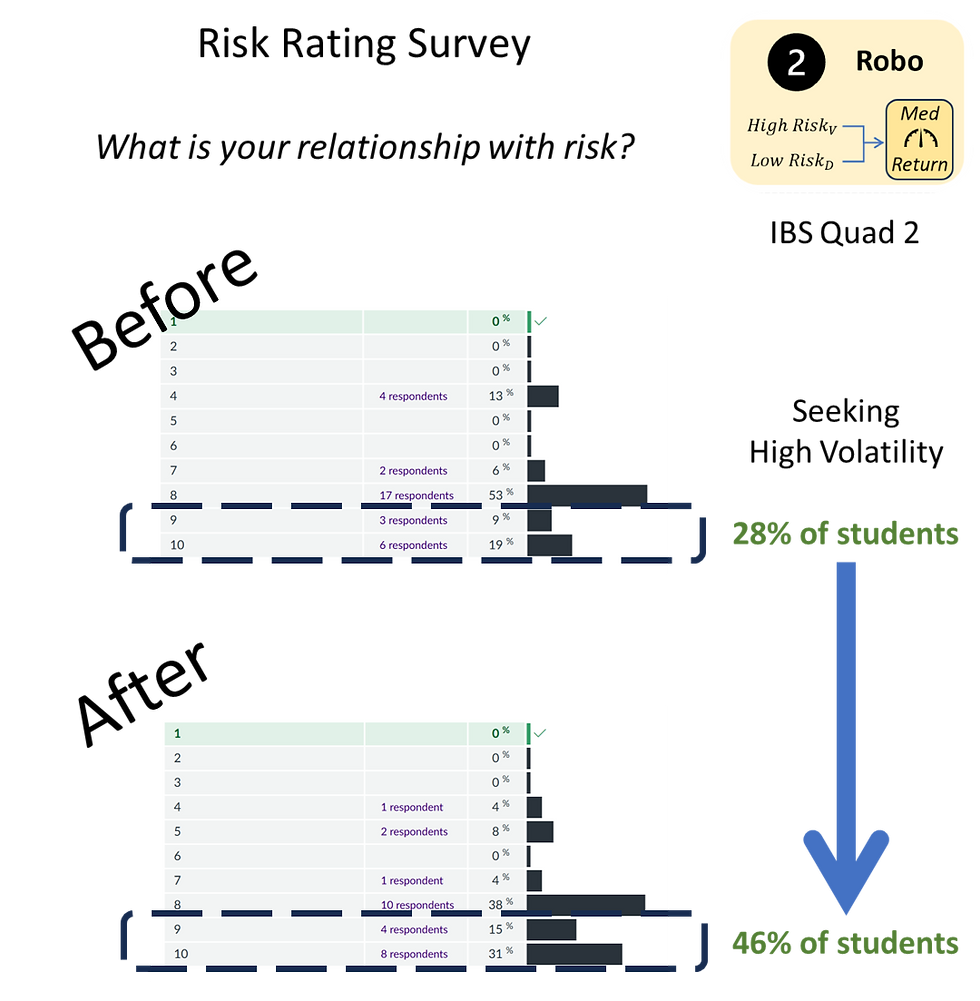
In my Behavioral Personal Finance course, I conducted action research to measure how moving from instinctual fear to process-driven logic impacts investment behavior. Using a pre- and post-module assessment, we tracked how students' relationship with risk evolved after learning the Investment Barbell Strategy.
I expect this will evolve for our students and clients as we move through the class, and after they get real-world experience. Our class provides the confidence to get started.
For more information on our Financial Education pedagogical research, please see:
PFR Pedagogy overview -> The PFR Pedagogy: How We Practice Getting Rich
College Student Investment Attitude Test Results -> Case Study: Quantifying the Impact of Process-Driven Risk Education on Investment Behavior
High School Curriculum research -> Elevating Financial Education in Virginia: A Decision-First Approach for a Data-Rich World


Thank you Prof. H…. my needle was moved :)